
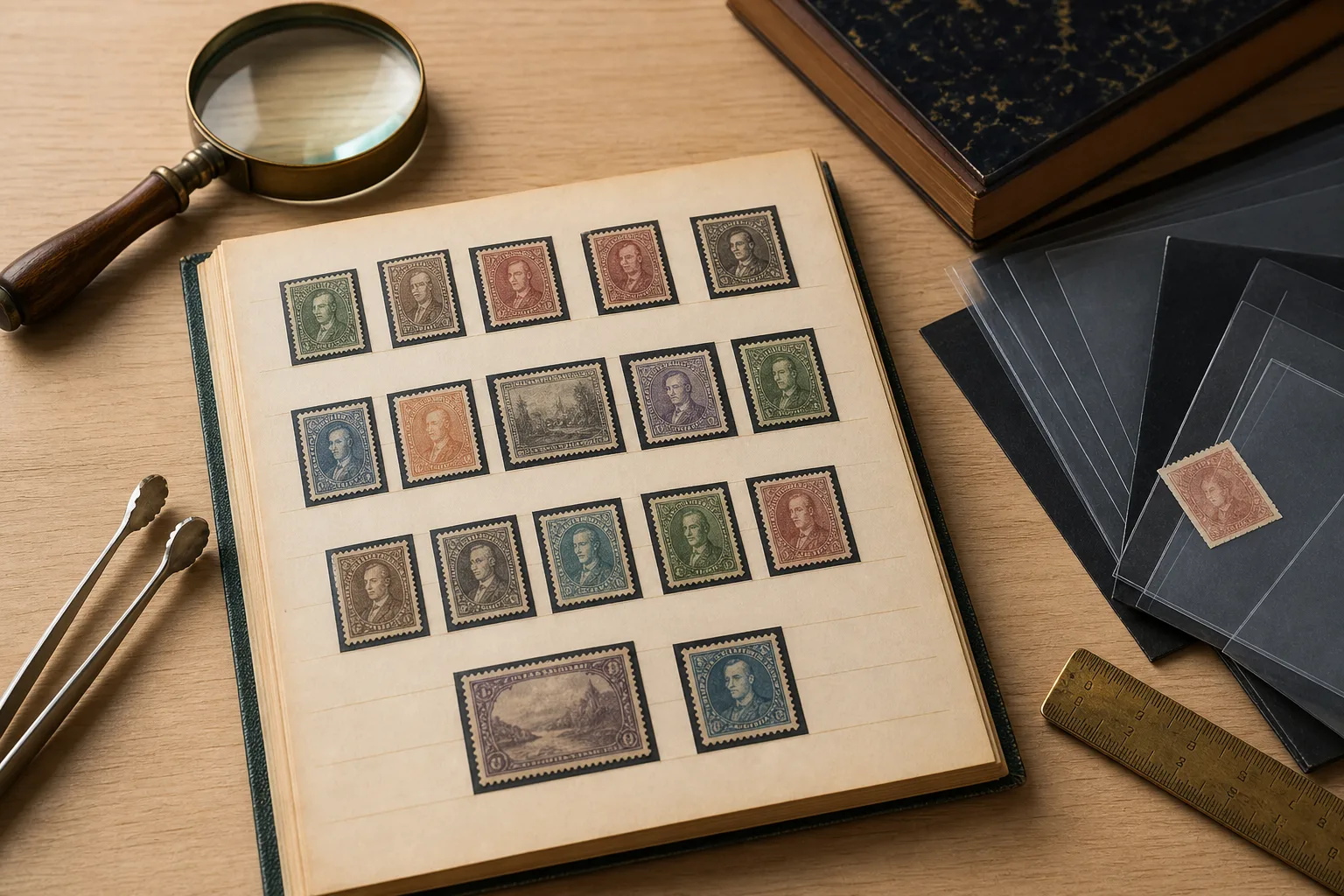
Most Elvis Presley postage stamps are common modern issues, so an ordinary used or unused single usually has a modest collector premium rather than a dramatic rarity value. Start by identifying the denomination, format, condition, and whether the item is a single, a pack, a pane, or a full sheet. A dealer listing for the commonly cited Elvis issue labels it as the 1993 29¢ Legends of American Music: Elvis Presley stamp and shows separate retail figures for unused and used examples. Source (accessed 2026-08-12)
Identify the stamp before estimating its value
Do not treat every Elvis-themed postage item as the same stamp. The denomination and the way the stamps are attached or packaged matter as much as the portrait.
- Common early issue: Look for a printed 29¢ denomination and an Elvis Presley design. The accessible dealer reference identifies its item as the 1993 Legends of American Music issue. Source (accessed 2026-08-12)
- Later Forever issue: A retail listing identifies a different Elvis product as a First-Class Mail Forever stamp in a sheet of 16. It should not be valued by applying a price for the older denominated issue. Source (accessed 2026-08-12)
- Single: One separated stamp. Check all perforations and the back before calling it unused with original gum.
- Pack, booklet, pane, or sheet: Keep it intact. The arrangement, selvage, wrapper, and original packaging can be part of what a buyer is purchasing.
If the date is the source of confusion, use the stamp’s denomination, design, and format first. Catalog or dealer pages may emphasize an issue date, while a marketplace title may use a production, copyright, inventory, or seller-entered date. A date in a listing title alone is not enough to prove that two otherwise similar items are different stamp issues.
What the available price evidence actually shows
The following examples are evidence points, not an appraisal and not a promise of what your item will sell for. They show why item type and price label must stay together.
| Item described by source | Price type | What it can tell you |
|---|---|---|
| Elvis Presley used single listed by a stamp dealer at $0.35 | Dealer retail price | A condition-specific dealer offering, not a completed sale. |
| Elvis Presley listing shown at $1.50 | Dealer retail price | Useful for comparison only after confirming the same condition and format. |
| Unused pack of 25 stamps described as having face value of 29¢ each | Seller description | Shows a pack is a different object from a loose single. |
| Unused pane described as containing 10 stamps and offered at $25.00 | Marketplace asking price | An asking price; it does not establish a realized market value. |
| Original-gum stamp listing offered at $13.23 | Marketplace asking price | Evidence that sellers ask different amounts, not proof that buyers paid them. |
Dealer evidence for the used and other Elvis listings: Source (accessed 2026-08-12). Pack description: Source (accessed 2026-08-12). Marketplace asking-price examples: Source (accessed 2026-08-12).
Face value, asking price, and collectible value are different
Face value is the postage denomination printed on a denominated stamp. A dealer price is the amount a dealer is prepared to ask, often with handling, stock selection, and a return policy built in. A marketplace asking price is simply a seller’s request. The strongest market evidence is a group of recent, genuinely comparable completed sales after postage, platform fees, and condition differences are considered.
For a common Elvis single, a high online listing is weak evidence by itself. Compare only like with like: used with used, never-hinged original gum with never-hinged original gum, and intact panes with intact panes. For a broader explanation of this distinction, see Postage Stamp Prices: Face Value vs Collector Value.
Condition can matter more than the image
Record what you see rather than guessing a grade. For an unused stamp, inspect the reverse for original gum, hinge remnants, thinning, disturbed gum, or spots. On the front, look for creases, tears, stains, fading, clipped or short perforations, and off-center cutting. For a used example, a clear cancellation can be preferable to a heavy smear, but it does not automatically make a common stamp scarce.
Do not soak, peel, press, reglue, or attempt to remove a hinge before offering the stamp. Those actions can change the item and make its condition harder to describe honestly. Handle it by the edges with stamp tongs if available, photograph front and back in even light, and retain any original wrapper or sheet margin.
A practical decision path
- It is a plainly used loose stamp: Treat it as a common collectible unless there is a clearly documented unusual feature. Compare it with used-single dealer and completed-sale evidence.
- It is a clean unused single: Photograph the gum and perforations. Do not assume “unused” means pristine; hinge marks and gum disturbance should be disclosed.
- It is an intact pack, pane, or sheet: Photograph the whole item and close-ups of corners, selvage, seams, and packaging. Keeping it whole preserves the option for a buyer who wants that format.
- It appears unusual: Pause before selling. Seek specialist review if there is a documented printing error, a credible variety, a noteworthy postal-history use, reliable provenance, or unusually fine condition. A color difference in a casual photograph is not enough on its own.
Can old Elvis postage still be used?
An unused denominated U.S. stamp remains postage at its printed value; if the current postage required is higher, additional valid postage is needed. USPS explains the current First-Class Mail framework and Forever-stamp use on its mailing page. Source (accessed 2026-08-12) If collectible presentation matters to you, remember that using the stamp on mail generally removes its unused-stamp appeal.
Buying or selling checklist
- State the denomination, design, format, quantity, and whether the item is used or unused.
- Show straight-on images of front and back; include any pack wrapper, pane margins, or sheet edges.
- Describe faults plainly instead of using “mint” as a catch-all term.
- Check recent completed sales, not only active listings, and compare the same format and condition.
- Subtract selling fees, payment charges, insured shipping, and safe packaging before deciding whether a sale is worthwhile.
- For a higher-priced claim of an error or variety, ask for expert support and avoid buying from photographs alone.
For a repeatable way to document any stamp, use How to Identify Your Stamps and Research Their Value. If you are sorting a larger group, Which Postage Stamps Are Valuable? helps put a common modern issue in context. For postage-use decisions, see Current Price of First Class Stamp.
Quick answer: are Elvis Presley stamps valuable?
They can have collector interest, especially in clean unused condition or intact formats, but the common denominated Elvis issue should not be presumed rare. Use documented condition and comparable completed sales to estimate a realistic selling range.
Quick answer: should a full sheet bring more than loose stamps?
It may, because collectors can value intact format, margins, and presentation. That premium is market-dependent. Compare completed sales for intact sheets or panes rather than multiplying a loose-single price.