
Most Valuable Stamps in the World
Most valuable stamps are rarely expensive because they are old alone. The stamps that sell for serious money usually combine extreme rarity, collector demand, condition, historical importance, and a clear story that can be verified by expert records or auction history.
Why the Most Valuable Stamps Become Valuable
Rare stamps become valuable when supply is tiny and demand is strong. A stamp can be scarce because very few were printed, because most were destroyed, because an error was quickly withdrawn, or because surviving copies are damaged and only a handful remain in collectible condition.
Condition matters heavily. Centering, color, gum, perforations, cancellations, paper, repairs, thins, stains, and provenance can change value by thousands of dollars. Two stamps that look similar to a beginner may sell at completely different levels if one is certified, well-centered, and fault-free.
That is why a simple “100 most valuable stamps” list can be misleading. Record prices are useful for context, but your own stamp needs identification, condition review, and market comparison before any value estimate is meaningful.
Rarity
Unique stamps, small surviving populations, and withdrawn errors create the strongest demand.
Condition
Fine centering, original gum, strong color, and no hidden faults can multiply the price.
Provenance
Certificates, auction records, and famous collections make valuable stamps easier to trust.
Most Valuable Stamps in the World: Famous Examples
The British Guiana One-Cent Magenta is the classic example. Sotheby’s described it as the sole surviving example of its kind and noted that it sold for $9.48 million in 2014. It later appeared again in the 2021 “Three Treasures” sale. Its value comes from uniqueness, history, and more than a century of famous ownership.
The Inverted Jenny is the best-known American stamp error. The Smithsonian National Postal Museum explains that only one sheet of 100 inverted center stamps was sold by the Post Office Department, and no additional examples have been discovered. Individual stamps and blocks from that sheet remain among the most famous items in U.S. philately.
Other famous valuable stamps include the Mauritius “Post Office” issues, the Treskilling Yellow of Sweden, the Baden 9 Kreuzer color error, the Hawaiian Missionaries, the Inverted Swan of Western Australia, and rare classic covers. Exact rankings change as private sales and auction records change, but the pattern is consistent: rarity plus proof plus demand.
When you read record-price claims, check the source behind the number. Auction houses, museums, expert committees, and major dealers are more reliable than copied list posts. For example, Sotheby’s and Stanley Gibbons both document the British Guiana story, while the Smithsonian provides historical context for the Inverted Jenny. That kind of record trail matters because rare stamp value depends on proof, not just a dramatic price tag.
What Valuable Stamp Lists Can and Cannot Tell You
A list of the most valuable stamps in the world can teach you what collectors care about. Many famous stamps are errors: inverted centers, wrong colors, unusual paper, incorrect inscriptions, or emergency local printings. Others are valuable because they were early issues from important postal systems or survive on historically important covers.
But a list cannot tell you what your stamp is worth. If you own a common stamp with a similar design, it may be worth very little. Famous rare stamps often have tiny details that separate them from ordinary issues. Watermark, perforation, plate position, shade, paper, and cancellation can all matter.
For practical research, use the stamp value guide to understand the basic factors, then compare actual completed sales rather than asking prices. A listed price is only a wish until a buyer pays it.
Could an Old Stamp in Your Collection Be Valuable?
Yes, but most old stamps are not automatically rare. Many old stamps were printed in huge numbers and remain common today. The better question is whether a stamp has the value signals collectors pay for.
Look for stamps from the 1800s, unusual colors, printing errors, strong condition, original gum, rare countries, high denominations, scarce cancellations, old covers, and certificates. If you inherited albums, do not assume the biggest collection is the most valuable. Often a few individual pieces carry most of the value.
If the material is mainly older, compare it with the old stamps value guide. That will help you separate age, rarity, and condition instead of treating every antique stamp as valuable.
How to Check Whether Your Stamps Are Worth Money
Start with identification. A stamp’s country, issue year, denomination, color, watermark, and design details are the foundation for every value estimate. Guessing from a picture online is risky because many valuable stamps have common lookalikes.
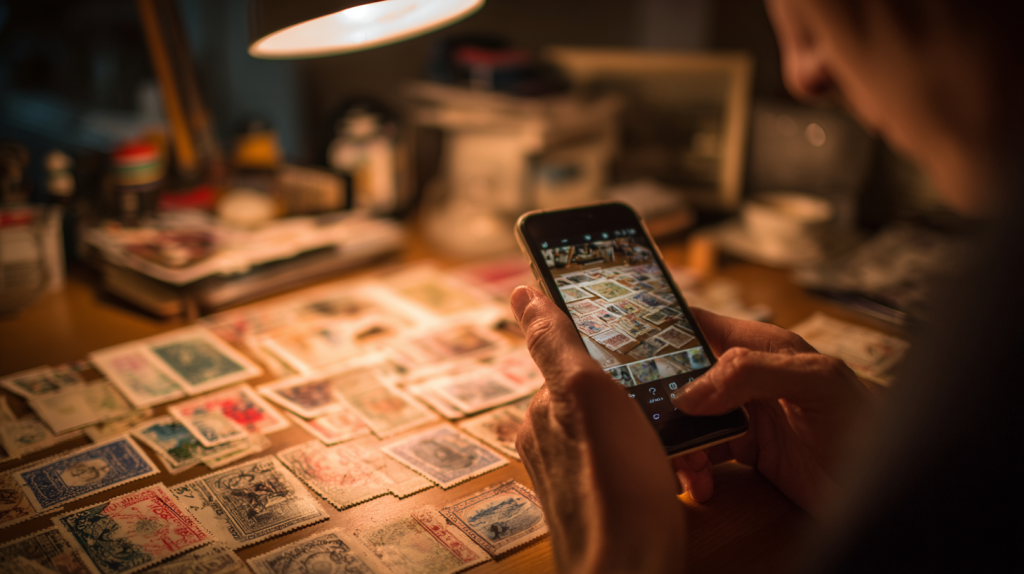
Use Stampy’s stamp value scanner to scan a clear photo and get a fast first read on identification, rarity clues, and estimated value. Then compare the result against catalog references, completed marketplace sales, and specialist auction records when the stamp looks important.
If you are checking many stamps at once, use the stamp collection valuation guide to decide which pieces deserve individual attention. This saves time and helps you avoid spending hours researching common material.
When to Get Expert Review
Get expert review when a stamp appears to be worth several hundred dollars or more, when a possible error is involved, or when you may sell, insure, donate, or divide a collection. Expertization can confirm whether the stamp is genuine, repaired, reperforated, regummed, altered, or misidentified.
A preliminary stamp collection appraisal can also help if you inherited a large group and do not know whether it is mostly common material or something stronger. For selling decisions, never rush a valuable-looking stamp into a bulk lot before checking it.
Quick rarity checklist
- Identify the country, year, denomination, and issue type.
- Check whether common lookalikes exist.
- Inspect condition, centering, paper, gum, perforations, and faults.
- Compare completed sales, not just asking prices.
- Use expert review for possible rare errors or high-value stamps.
- Before selling, read how to sell a stamp collection safely.
Check whether your stamp has value signals
Download Stampy to identify stamps by photo, estimate value, and find which pieces in your collection deserve deeper research.
Record Auction Results: What the Rarest Stamps Actually Sold For
Public auction records give the clearest picture of what the world’s rarest stamps are worth. These widely reported results set the benchmarks collectors use today:
| Stamp | Year issued | Reported result | Why it matters |
|---|---|---|---|
| British Guiana 1c Magenta | 1856 | About $8.3 million (Sotheby’s, 2021) | The only known example; often called the world’s most valuable stamp |
| Inverted Jenny (single) | 1918 | Just over $2 million (2023) | America’s most famous printing error — the airplane printed upside down |
| Treskilling Yellow | 1855 | Reportedly around $2.3 million (1996, later private sales) | A Swedish color error with a single known copy |
| Sicilian Error of Color | 1859 | About €1.86 million (2011) | One of only two known examples of this color error |
| 1868 Benjamin Franklin Z-Grill | 1868 | Valued in the millions; famously traded for an Inverted Jenny plate block | Only two known copies, one in a museum |
| Mauritius “Post Office” pair | 1847 | Multi-million results at auction over the years | Among the first stamps issued outside Great Britain |
Notice the pattern: every record-setter combines extreme rarity (often one or two known copies), a famous story, and documented provenance. Age alone appears nowhere on that list.
Rarity vs Demand: Why Most Old Stamps Are Not Valuable
The uncomfortable truth of philately is that most stamps printed in the last 150 years survive in enormous quantities. A stamp from the 1930s printed in the hundreds of millions is old, but it is not rare — and without collector demand, even a scarce stamp can sit unsold. Value appears only where limited supply meets active demand: printing errors, short-lived issues, rare postal uses, and stamps from small or short-lived territories. That is why a systematic check of each stamp’s identity, variety, and condition beats any assumption based on age.
Most Valuable Stamps FAQ
What is the most valuable stamp in the world?
The British Guiana One-Cent Magenta is usually treated as the most famous record-holding stamp because it is unique and has repeatedly set major auction records.
Are old stamps always valuable?
No. Age helps only when combined with rarity, condition, demand, and correct identification. Many old stamps were printed in large numbers and remain common.
What makes a stamp worth a lot of money?
The biggest factors are rarity, condition, collector demand, provenance, expert certification, printing errors, postal history, and whether similar stamps have actually sold for strong prices.
Can a stamp scanner find rare stamps?
A scanner can help identify stamps and flag value signals, but very rare stamps still need expert review. Use scanning as a first screening step, not the final certificate.
Should I sell a valuable-looking stamp immediately?
No. If a stamp looks valuable, check identification, condition, completed sales, and expert opinion first. Selling too quickly is how strong material gets underpriced.
What are the top 10 rarest stamps?
Rarity and price do not always match, but the names that appear on almost every specialist list are the British Guiana 1c Magenta (one known copy), the Treskilling Yellow, the Mauritius Post Office pair, the Sicilian Error of Colour, the Inverted Jenny, the 1868 Benjamin Franklin Z-Grill, the Baden 9-Kreuzer error, the Hawaiian Missionaries, the Basel Dove, and the Penny Black’s rarest plate varieties. Each combines very few surviving examples with documented provenance.
What is the holy grail of stamps?
Collectors usually give that title to the British Guiana 1c Magenta of 1856: a single known copy exists, and it has changed hands at auction for roughly 8.3 million dollars. American collectors sometimes reserve the phrase for the 1868 Z-Grill, of which only two copies are known and one sits permanently in a museum, making it effectively unobtainable.